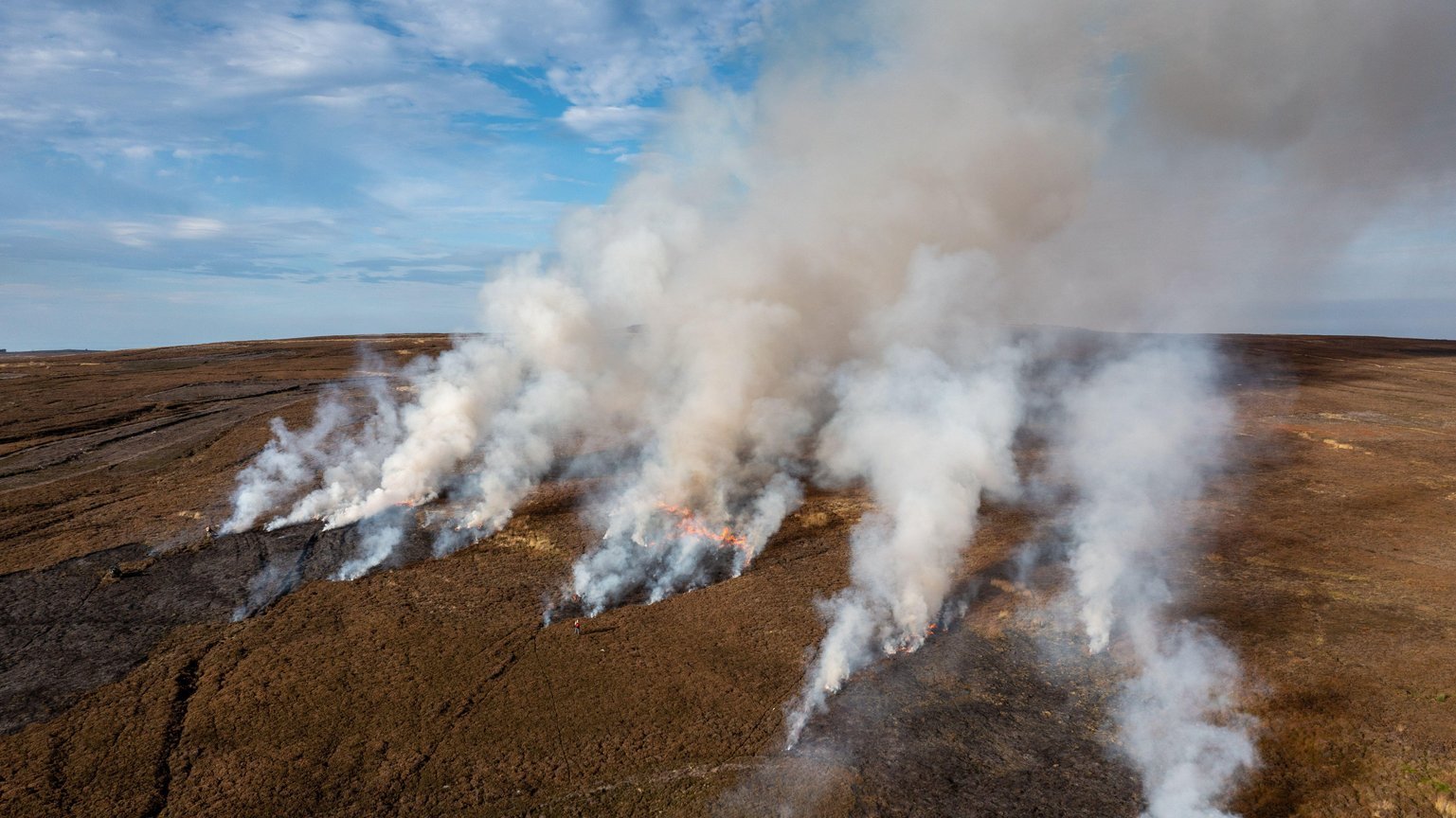
Moorland burning or muirburn (‘muir’ is a Scots word for moor) is the deliberate, controlled burning of moorland vegetation. It is sometimes done to encourage new growth for livestock but is most closely associated with moors managed for driven grouse shooting. Patches of heather and grass are burnt on an annual rotation, to provide new shoots for the grouse. Over the course of the rotation, most of the vegetation on a moor will be burnt.
Humans have used fire to control vegetation for thousands of years. Typically, burning helped to clear trees and bushes so the land could be farmed. Only in the past 150 years has it become part of the intensive management of grouse moors. Now, more than 5% of land in the UK is subject to this new regime, including large areas on peat soils, and within our upland National Parks and protected wildlife sites.
Rotations vary but, each year, perhaps 10% of the vegetation is burnt, in patches scattered across the moor. When the rotation is complete, in 10 years or so, and the whole moor has been burnt, the cycle begins again.
Burning on grouse moors creates a distinctive, artificial landscape that is easy to recognise. Moors are dominated by vegetation just a few inches above the ground, made up of plants no more than a few years old. The burnt patches are visible from afar, being obvious even in satellite images. Red Grouse respond well to this, enjoying the nutritious new shoots that grow from the burnt areas. In conjunction with rigorous predator control, burning allows the grouse to reach the high densities needed for driven shooting.
Burning is poorly regulated, something that government has finally begun to recognise. New regulations were introduced in 2021 to restrict the most damaging burning on deep peat in England, and these were updated in September 2025 which further restrict the 2021 regulations for burning over specific areas of peatland, specifically limiting the depth of peat where fires can be lit. In Scotland, a licence will be required for burning vegetation from autumn 2026.
Burning creates a whole raft of different problems that have adverse effects on wildlife, local residents and the wider community:
Air pollution: Smoke from the fires is carried into local communities where people are forced to breathe it in, including fine particulates linked to asthma, heart disease and some cancers (this is why burning crop stubbles was banned over three decades ago). Even cities are affected, including Sheffield on the edge of intensively managed moors in the Peak District National Park.
Water pollution: Charred ground, with exposed, bare soil allows sedimented water to run off the moors into local rivers, harming aquatic life and causing discolouration in our water supplies which increases the cost of treatment – costs which are passed on to paying customers.
Flood risk: Heavy rain drains easily from bare, eroded ground and short vegetation, running swiftly down into the valleys below. The residents of Hebden Bridge, below intensive grouse moors, know this only too well, having had their houses flooded more than once. This problem will only get worse as the impacts of climate change begin to bite and rainfall becomes more intense.
Damage to wildlife habitat: Moors repeatedly burnt back to bare ground create artificial and constrained landscapes. A handful of birds of open country (the grouse especially) do well but there is little variety. An autumn walk will reveal the ubiquitous grouse and Meadow Pipits but not much else. For any species that require bushes or trees to make a living, you will have to look elsewhere.
Direct loss of wildlife: Burning kills wildlife that is unable to escape the flames. Reptiles such as Common Lizards and Adders are affected, as are birds that nest early in the season. Burning is allowed up to 15 April in England and Scotland (with extensions beyond even that date) and because birds breed earlier than they once did due to the warming climate, eggs and chicks are increasingly lost to the flames. The new legislation in Scotland, when it becomes enacted, is expected to ban burning from 31 March but licences may be issued in ‘exceptional circumstances’ to permit later burning dates.
Contributing to climate change: Peat locks up carbon more effectively than trees, but burning exposes the surface to drying and degradation, releasing carbon into the atmosphere. Damaged blanket bogs, where peat once accumulated, now contribute to climate change rather than helping to mitigate its effects.
Put simply, we should not be burning vegetation on peat soils. It’s staggering that we continue to create moonscapes of charred vegetation and bare soil across more than 5% of the UK. All so a tiny number of people can indulge in a niche leisure activity for a few weeks each year. There is no clearer example of the wholesale destruction of public goods for (minimal) private gain.
Government has finally acknowledged the problems and is taking tentative steps towards addressing them, constrained, as always, by influential vested interests. New regulations for England have amended the definition of deep peat, where burning is not permitted without a licence, to 30 centimetres (from 40 centimetres), and has widened the area to which the legislation applies. In Scotland, a licencing regime will apply to all burning from autumn 2026, to help reduce adverse environmental impacts. These changes are welcome, cautious as they are, though much will depend on how effectively they are implemented and enforced.
Moor owners, seeing that the game might be up, but desperate to continue burning for grouse, have one last trick. Burning, they now suggest, is about making wildfires less likely. And, yes, it’s true that if you set fire to every scrap of vegetation in a ten-year period, there won’t be much left to burn. There are far better ways to protect valuable upland vegetation. Many moors have been drained to improve conditions for grouse. If these drains are blocked, the moors will hold more water and become less flammable. Allowing bushes and trees to become established in drier areas would also help; they don’t burn as easily as the artificial monocultures of heather. And firebreaks can be established where needed.
These solutions are sustainable and long-lasting. They would allow us to leave behind an era in which we look after peatlands by razing the vegetation to the ground for grouse. And they would benefit local communities, improve water and air quality, reduce our water bills, improve flood defences, protect vitally important carbon stores and help maintain (and restore) our beleaguered upland wildlife.