
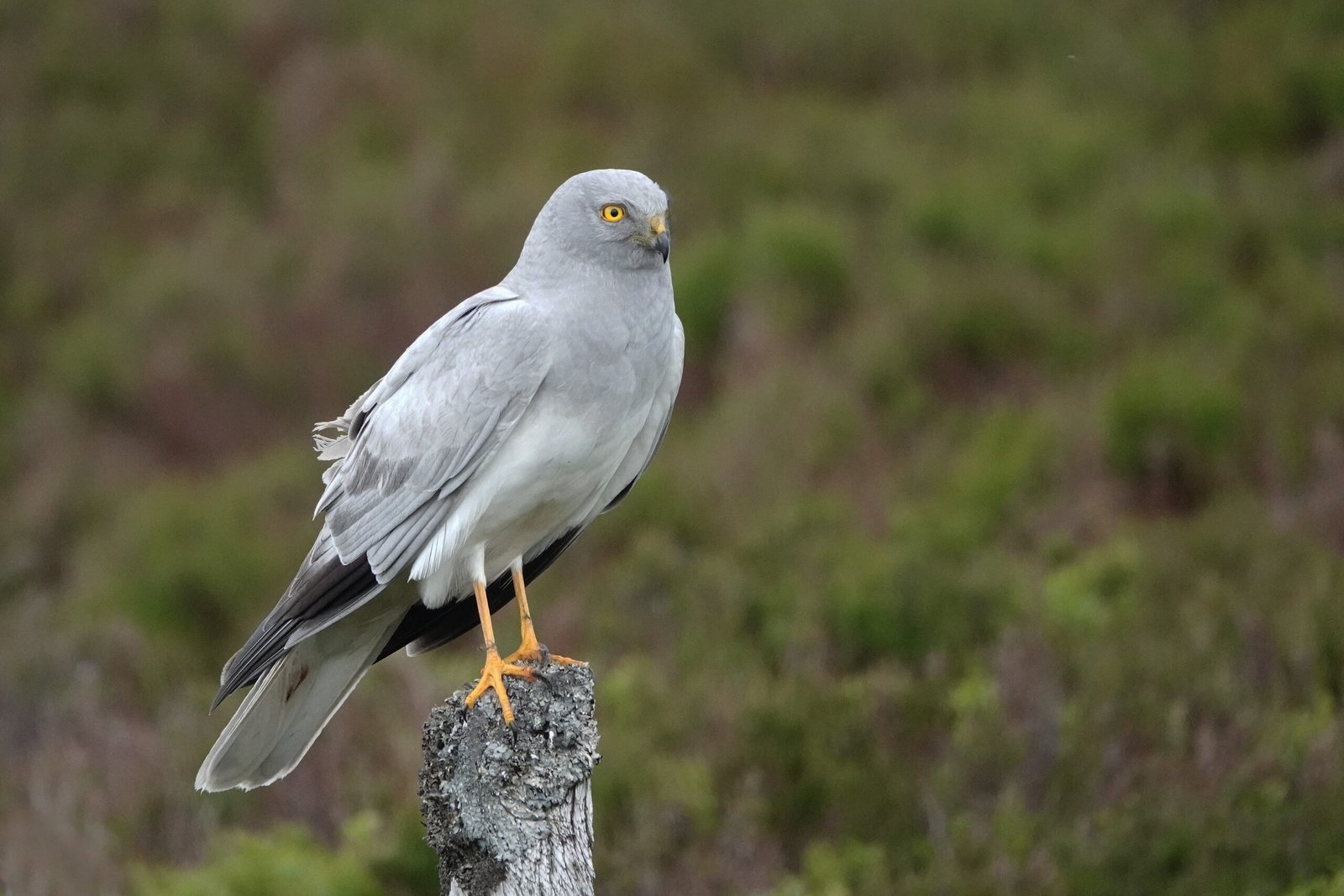
Watch a ghostly male Hen Harrier skimming low across the heather, owl-like face tilted towards the ground, and there is no doubting its appeal. This is a truly beautiful bird. Even so, it receives a surprising amount of attention in discussions about Driven Grouse Shooting (DGS). Why is this? Well, firstly, along with the Merlin, it is highly dependent on moorland and regularly uses grouse moors for hunting, roosting and nesting. Secondly (and unlike the Merlin) it is big enough to hunt Red Grouse, taking full-grown birds as well as chicks. That has been its downfall.
The Hen Harrier was once a much more common bird throughout Britain, including in the lowlands, until persecution took its toll. By the early 1900s it clung on only in Orkney and a few islands off the west coast of Scotland. A slow recovery picked up pace during the Second World War, when gamekeepers were away dealing with a different enemy. By 2004, the UK population had slowly climbed to 749 pairs.
But as it became more common, so the old conflicts were rekindled, and it made little difference that there were now new laws in place to protect our raptors. The recovery stalled and numbers dipped once more, with an estimated 653 pairs by the time of last national survey in 2023. In England, what appeared to be the start of another modest recovery has faltered: there were 54 breeding attempts in 2023, falling to 39 attempts in 2025 and of those, only three were on privately-owned grouse moors; the other 36 breeding attempts all took place on land managed for conservation.
Thanks to some groundbreaking, government-funded science, we have an excellent understanding of how many Hen Harriers should be gracing our uplands. This work showed that there is sufficient habitat for over 2,500 pairs in the UK, including at least 323 pairs in England. Currently, illegal persecution means that we have only 26% of the pairs that should be present in the UK. In England the figure is just 12%.
Over the years, various initiatives under the banner of conflict resolution have been tried, with conservationists engaging with grouse moor representatives in the hope of improving the Hen Harrier’s fortunes. All have failed for the same reason: if you want to maximise the number of targets for the guns on your driven grouse shoot then, as explained below, illegal persecution is seen as an essential activity.
Conflicts with birds of prey are often exaggerated, the raptor blamed unfairly for causing damage to livestock, which is committed rarely or even not at all. But fears about the Hen Harrier are well founded. Studies have shown that it eats a lot of Red Grouse. On intensive grouse moors, this is a serious problem. With harriers present, when grouse numbers dip, as they periodically do due to variations in habitat conditions and weather, they struggle to build up again to a level where shooting is viable.
Even with a healthy grouse population, the Hen Harrier still kills birds that would otherwise be available for paying customers, and it disrupts shooting by overflying the moors on shoot days. This can ‘spook’ the grouse, causing them to fly to another part of the moor, or making them sit tight so it becomes more difficult for the beaters to drive them towards the guns.
In a rare moment when the mask slipped, Amanda Anderson, then Director of the Moorland Association told a journalist that ‘if we let the Hen Harrier in, we will soon have nothing else.’ And so keepers continue to keep them out. They do this by shooting, trapping and poisoning the adults, by deliberately disturbing birds at the nest, by stamping on eggs and chicks, and by burning out the patches of long heather that are used for nesting.
Prosecutions are rare because it is difficult to identify the individuals involved. But the evidence is overwhelming. As well as a litany of individual incidents, some on camera, there is the work of Natural England, and others, monitoring the progress of tagged birds. After years of painstaking tracking, they concluded, in the couched, cautious language of a scientific paper, that ‘Hen Harriers in Britain suffer elevated levels of mortality on grouse moors, which is most likely the result of illegal killing.’ No less than 72% of satellite-tagged birds were confirmed, or considered likely, to have been illegally killed, and this was ten times more likely to occur on land managed for grouse shooting relative to other land uses. This, writ large, is the work of moorland gamekeepers ‘not letting them in’.
We believe that DGS is an industry out of control. For a whole variety of different reasons, of which the relentless slaughter of Hen Harriers is one, it needs to be banned (link to DGS piece). For as long as required, we will campaign to bring this about.
But until the ban comes, there must be a greater focus on tackling persecution (link to raptor persecution piece). The use of new monitoring and surveillance technology such as remote cameras, drones and ever more accurate tags, allied to a greater investigative effort by the police, would help bring more of the criminals to justice.
We are horrified by the so-called solution of brood management, which we refer to as brood meddling. This scheme was trialled by Natural England between 2018 – 2024 as a concession to grouse moor managers; a reward, if you like, for their persistent crimes. Now, instead of illegally killing them, the pesky Hen Harrier nestlings could legally be taken into captivity (leaving the adults with nothing) to reduce the predation of grouse, before being released elsewhere at the end of the breeding season. And yet, all the time the trial was running, the relentless killing of harriers continued, and continues to date. We know of at least 147 Hen Harriers that have been illegally killed or that have ‘disappeared’ in suspicious circumstances since 2018, most of them on, or close to, driven grouse moors. After an uptick in breeding harriers in England, numbers are declining once more. Over £1 Million was spent on this meddling with a rare wild bird. We consider the trial to have been an abject, embarrassing failure (link to brood meddling report). Now that it is over, we will strongly oppose any further attempts to licence brood management in the name of Hen Harrier ‘conservation’.
We also have reservations about the proposed lowland reintroduction of Hen Harriers to southern England and are pleased that the idea has, apparently, been shelved. This would have been another expensive distraction – another way of drawing attention away from the real problem.
Just one thing needs to happen for this bird to do well: the criminals associated with driven grouse shooting need to stop killing them. We ask for nothing more. Partnership working and compromise has its place in conservation, but it will rarely succeed when you are up against the intransigence of organised criminality and its influential supporters in the British establishment. If a niche leisure activity can only be sustained in this way, it has no place in modern Britain.