
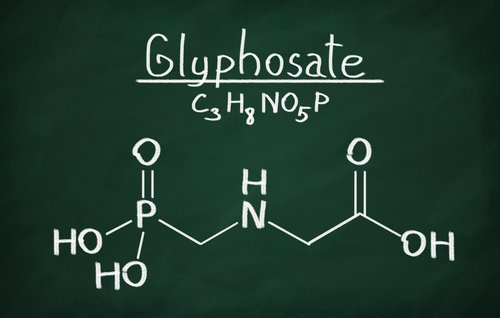
Pesticides to kill invertebrates, fungi or plants are widely used by farmers, local authorities and householders. By their nature they tend to involve hazardous chemicals and so we rely on good regulation to keep us safe and protect the environment. Glyphosate is a powerful herbicide (or weedkiller) sold under various tradenames, of which ‘Roundup’ is perhaps the best known. It has a high profile because it is believed to be hazardous to humans and the environment, and yet it is widely used in both rural and urban areas. It might surprise you to learn that almost all of us are exposed to it (see below).
Pesticides are ubiquitous in modern Britain. A visit to the local garden centre will reveal shelves stacked high with insecticides, fungicides and weedkillers. When it comes to commercial or municipal operators, including farmers and local authorities, the range of pesticides is even greater, and it includes more powerful formulations of products available for domestic use.
Pesticides go through a process of risk assessment and only those deemed safe (or safe enough) make it onto the shelves. The risk assessments inform restrictions on the way each product can be used so that risks to human health and the environment are minimised. These are legal requirements, summarised on the label, that set out how a product must be used.
In addition, there is overarching legislation that governs how commercial operators and public bodies use pesticides. For plant protection products, including glyphosate, public bodies must ensure:
Our regulators and enforcement bodies are responsible for checking how these hazardous products are being used and taking effective action when the law is not being followed.
Land managers are frequently obsessed with tidiness. In rural and urban areas alike, wherever wild plants spring up, it seems a worker with a strimmer or toxic spray will not be far behind to deal with them, along with the insects that were living on them. In urban areas this is done on our behalf, and at our expense. That toxic spray is very likely to be glyphosate.
There has been much debate about the dangers of glyphosate with some international authorities, including an agency of the World Health Organisation, classifying it as ‘probably carcinogenic to humans’. Studies show that even at low concentrations it can damage organs and skin cells and there is evidence it can accumulate within human cells. It has been banned or heavily restricted in some countries and many cities across the world.
Environmental harms include adverse effects on invertebrates, including earthworms and other soil organisms, and toxic effects on aquatic life when it finds its way into water bodies. Amphibians are thought to be especially vulnerable.
In places where it is deemed safe enough to use, as here in the UK, we rely on users to follow their legal obligations. And herein lies the problem: our work has shown that most local authorities are not sticking to the rules. They make little effort to consider safer methods of plant control (or whether it is necessary in the first place), or to keep usage of glyphosate to a minimum, or to use it in a way that ensures the risks are minimised. In short, they ignore their legal obligations, putting human health at increased risk and causing unnecessary damage to the environment.
If you don’t use glyphosate then you may think you don’t have much to worry about. But that would be a mistake. Our work has shown that over 80% of people who had their urine tested had glyphosate in their system, at varying levels. Interestingly, contamination rates were higher in urban than rural areas (though not significantly so). Exposure to this insidious chemical, with effects that may not become apparent for many years, is an issue that affects us all.
There is a huge range of pesticides with the potential to harm human health and the environment if they are not used appropriately. We are not experts on pesticides and so, like everyone else, we rely on regulations to ensure they are used as they should be, only when they are really needed, and according to the rules. This is especially important for a chemical like glyphosate that is in widespread use and for which serious health and environmental concerns have been raised.
It really shouldn’t fall to small organisations like Wild Justice to raise the alarm about the illegal misuse of harmful chemicals in an environment we all share. Our findings that most local councils disregard their obligations when using glyphosate raises broader concerns. If the rules that apply to glyphosate can be ignored, what about all the other hazardous chemicals that have stringent requirements for safe use? What does this say about our regulatory regime and the enforcement of the rules in place to protect human health and the environment in our gardens, parks and countryside?
We believe that essential regulations are all too often dismissed as ‘red tape’ and seen as no more than an irritating inconvenience. How often does our government promise to sweep them away to save time and money. We don’t see it like that. The regulations that apply to glyphosate and other toxic chemicals are there for a reason. They are there to protect us. We ‘sweep them away’ or fail to enforce them effectively at our peril.